Sunday, October 18, 2015

"New leaders need a little extra care"/ 16 job interviews

Aug. 25 "New leaders need a little extra care": I cut out this article by Harvey Schachter in the Globe and Mail on Aug. 24, 2015.  It is a hard job to be a manager.  It's also hard to get into a new role.  Here is the whole article:

Bill Gentry is a first-time manager. He also is a researcher who has studied the difficulties people new to management face, and through his work at the Center for Creative Leadership, has trained new managers. “The biggest thing is that what made you a successful individual contributor won’t work now that you lead others,” he said in an interview.

That means first-time managers in your organization need your help. You can’t just throw them into the new job and expect them to succeed because they have been top-flight before. Unfortunately, almost 60 per cent of managers say they never received any training when they transitioned into their first leadership role.

You need to be honest about the challenges, so they aren’t surprised when things don’t go smoothly and don’t feel they are the only person who has ever struggled with the transition. You also need to tell them they are supported – and show it. The Center’s research shows that when people feel backed by their supervisors and organization, they have higher job satisfaction, higher commitment to the organization, and are less likely to want to leave.

Three leadership challenges predominate:

1. Asserting authority

Fifty-nine per cent of managers cite this difficulty, as they struggle to establish or assert their new authority. “You are going from BFF to boss and it’s a big challenge. You can’t have the same relationship with your colleagues,” he said. You may be able to keep the friendships, but they’ll be different or you may even lose them.

2. Developing managerial effectiveness

The new manager will be concerned with being an effective leader but at the same time needs to be productive at their own work, which often must be maintained at this initial supervisory post. Forty-six per cent of those surveyed highlighted this issue. “We need as managers to figure out time when we can do our own work and also when to be doing coaching and performance appraisals and other managerial tasks,” he said.

3. Leading team achievement

Before, you just led yourself. Now you must lead others, forging team chemistry, and 43 per cent signalled their difficulty adjusting to this challenge. This can be particularly demanding when directions, goals or expectations are unclear.

In a research paper and during the interview, Mr. Gentry offered advice on handling each of those problems. In establishing your role as a new manager, you must be clear and direct, setting the tone for how you will deal with your new subordinates.

First, acknowledge to yourself that the relationship with former peers must change. Then meet with them, and talk openly about the new situation. In particular, you have to ensure your relationship with people you are close with won’t lead to accusations you are favouring them as the new boss. “Be clear and firm. Ask how you can work together so that they are treated fairly and others see the treatment as fair,” he advised in the interview. “Be prepared that the friendship may end.”

As soon as the promotion is made, the new manager should set up a meeting with each direct report to focus on that individual’s needs and motivations, learning what each likes about his work, how each likes to be led and whatever concerns exist. The new manager will also want to outline his vision for the future, but learning about his or her followers comes first.

Supervisors of first-time managers can also help them with developing managerial and personal effectiveness. Work closely with them to set specific, measurable goals. Encourage them to maintain an overall list of responsibilities and active projects for their entire team.

That list can help them to see the bigger picture. Get them to think about how often they should be holding one-on-one meetings with their team members. And finally, encourage them to use one calendar for work and all their other activities instead of maintaining separate calendars for different spheres, which leads to confusion. That sounds elementary but he says a surprising number of people run into trouble on this score.

As for leading team achievement, he preaches an approach known as DAC, for direction, alignment and commitment. The manager must tell subordinates the vision and check that everyone knows their role and the role of their colleagues in reaching that goal. Then, through those one-on-ones, the manager must understand what motivates each individual and how to apply that to attaining their goals. As well, the first-time managers should be saying “together” a lot – using that term improves productivity – and dealing with conflict as soon as it arises.

First-time managers can gain support through what are known as “circles,” having all the rookie supervisors in an organization meeting regularly to share the issues confronting them. If a more senior manager can attend those sessions, as mentor, that’s even better.

First-time managers usually oversee the most people in an organization. Hoping they’ll be successful is not a strategy. When you promote them, you need to wisely support them.


"I've had 16 job interviews, but no offers. What am I missing?": I cut out this article in the Globe and Mail on Aug. 24, 2015.  Now this is a good article that I had interest in reading.  I have done lots of job interviews and not get hired, but some I do get hired.  I have gotten feedback right from the interviewer.  Here's the whole article:

THE QUESTION

I am 35 years old, currently living outside the country with my parents. I have two master’s degrees from the United States and London in fine arts and media relations. I want to work in the business side of the entertainment business in the U.S. or Canada. I have had a number of short-term positions over the past five years, and 16 interviews over the past 10 months for full-time positions with no job offers. Am I overqualified, or do I not have enough long-term job experience? What do I need to do to land a position?
 
THE FIRST ANSWER
Bruce Sandy

Principal, Pathfinder Coaching and Consulting, Vancouver

You need to find out specifically why you were not selected for any of these positions. Ask for specific feedback from the company or human resources officials about what they liked about your interviews and what you need to change in your presentation or your references. Ask if they think you are overqualified and what you need to do to land a position with their companies. Take note of their comments and recommendations.

If there are identified problems with your presentation and interview style, consider working with a career coach or counsellor to refine and hone your communication, presentation and relation- ship-building skills. Practise interviews and videotape them. Get specific feedback on your communication style, body language, tone and connection with the interviewer. If there are problems with your references, find new ones. They should have a recent copy of your résumé and copies of the job ads for which you are applying. You need to know whether they can fully support you and what they will say about you during reference checks.

Go to the U.S. and Canada and start networking with key officials in entertainment companies. Attend local entertainment business events. Build your network. Set up information interviews with key company officials. Remember to ask them what they are proudest of and what the key challenges are for their companies instead of just focusing on you and your need for a job. If they feel you are a good listener and someone who can help them, they will want to find out more about you and how you might fit.

THE SECOND ANSWER
Billy Anderson

Founder, the Courage Crusade, Toronto

The best feedback for you is in the heads of the 16 people who turned you down. Did you ask them why you didn’t get the position? It’s even better to ask at the end of the interview: “Now that we’ve spoken, do you see any gaps between what I offer and what the position requires?” It takes courage because we don’t always want to hear the answer.

Roughly 80 per cent of jobs are found through connections. Have you fully leveraged yours? Not just who you know, but who those people know.

Have you exhausted opportunities in the country you’re residing in now? The more experience you can get at home, the better your résumé will look and the more connections you’ll make.

You have a lot of education, but is it applicable to what you’re applying for? What type of position or company would it most align with? Start there.

You could call some colleges in North America, tell them you’re thinking of taking some courses to improve your odds and ask what the industry typically requires. Tell them your situation.

Can you afford financially to start as a volunteer if need be, and slowly work your way up once you’ve proved yourself?


There was 1 comment on the article: I tried to copy and paste it, but I can't.  It was basically that getting 16 job interviews is really good.  Maybe it's just me, but the comment writer sounds like a young woman in her early 20s.

Myglobe67 20 hours ago
16 interviews -- well done! Many people in the job market would give their right arm for 16 interviews. Each interview makes you a stronger and better candidate for the next job, and provides you with more information about the industry and market (in your case, the entertainment business). Each interviewer is also a networking contact for the future in their company - or whatever company they may land at in the future. Keep their contact details.

The commentators give you a lot of conventional advice -- like ask for feedback from the interviewer. LOL! I have never had nor heard of interviewers giving feedback -- they just want to move on with the candidate they have selected and not waste time with feedback. In many large organizations, feedback is discouraged if not prohibited, since they fear that feedback will only give candidates a chance to rebut the interviewer's conclusions, or even worse, ammunition for some sort of complaint.

There is so much advice in the HR and job-hunting world, please take it all with a big helping of salt, including mine! Having said that, my two suggestions for you:

-- Network on LinkedIn
-- for your industry, try playbackonline.ca
Myglobe67 20 hours ago
16 interviews -- well done! Many people in the job market would give their right arm for 16 interviews. Each interview makes you a stronger and better candidate for the next job, and provides you with more information about the industry and market (in your case, the entertainment business). Each interviewer is also a networking contact for the future in their company - or whatever company they may land at in the future. Keep their contact details.

The commentators give you a lot of conventional advice -- like ask for feedback from the interviewer. LOL! I have never had nor heard of interviewers giving feedback -- they just want to move on with the candidate they have selected and not waste time with feedback. In many large organizations, feedback is discouraged if not prohibited, since they fear that feedback will only give candidates a chance to rebut the interviewer's conclusions, or even worse, ammunition for some sort of complaint.

There is so much advice in the HR and job-hunting world, please take it all with a big helping of salt, including mine! Having said that, my two suggestions for you:

-- Network on LinkedIn
-- for your industry, try playbackonline.ca
Myglobe67 20 hours ago
16 interviews -- well done! Many people in the job market would give their right arm for 16 interviews. Each interview makes you a stronger and better candidate for the next job, and provides you with more information about the industry and market (in your case, the entertainment business). Each interviewer is also a networking contact for the future in their company - or whatever company they may land at in the future. Keep their contact details.

The commentators give you a lot of conventional advice -- like ask for feedback from the interviewer. LOL! I have never had nor heard of interviewers giving feedback -- they just want to move on with the candidate they have selected and not waste time with feedback. In many large organizations, feedback is discouraged if not prohibited, since they fear that feedback will only give candidates a chance to rebut the interviewer's conclusions, or even worse, ammunition for some sort of complaint.

There is so much advice in the HR and job-hunting world, please take it all with a big helping of salt, including mine! Having said that, my two suggestions for you:

-- Network on LinkedIn
-- for your industry, try playbackonline.ca

Myglobe67 20 hours ago
16 interviews -- well done! Many people in the job market would give their right arm for 16 interviews. Each interview makes you a stronger and better candidate for the next job, and provides you with more information about the industry and market (in your case, the entertainment business). Each interviewer is also a networking contact for the future in their company - or whatever company they may land at in the future. Keep their contact details.

The commentators give you a lot of conventional advice -- like ask for feedback from the interviewer. LOL! I have never had nor heard of interviewers giving feedback -- they just want to move on with the candidate they have selected and not waste time with feedback. In many large organizations, feedback is discouraged if not prohibited, since they fear that feedback will only give candidates a chance to rebut the interviewer's conclusions, or even worse, ammunition for some sort of complaint.

There is so much advice in the HR and job-hunting world, please take it all with a big helping of salt, including mine! Having said that, my two suggestions for you:

-- Network on LinkedIn
-- for your industry, try playbackonline.ca

"Woman uses sword as self-defense"/ Homeless Veteran/ Rob Ford

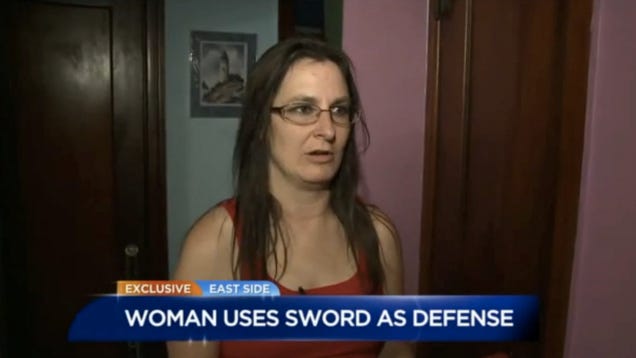
 Oct. 12 "Woman uses sword as self-defense": I found this through MSN:  

Karen Dolley, a 43-year-old Indianapolis woman who skates as “Foul Morguean” with the Naptown Roller Girls, cornered a man who’d broken into her home on Thursday night, using only her wits, bravery, and a Japanese-styled sword she owns, called a “ninjato.”
The Indianapolis Star reports that Dolley punched the intruder, Jacob Wessel, 10 times, cornering him in her bedroom:
She reached for her gun in a nearby drawer, but she accidentally opened the wrong drawer during the chaos of the moment, so her gun wasn’t there.
She reached for her backup weapon, a Japanese-styled sword called ninjato, which she keeps near her bed. Her intruder crouched in the bedroom as she held him at sword-point until police arrived, she said.
She called 911 and police arrived within two minutes, she said.


Oct. 13 Passer-by foils abduction attempt: I found this on Yahoo news: "An abduction attempt in France went wrong for the perpetrators when a passer-by got involved, appearing to rescue the victim."

2 guys were going to abduct another man.  However, an old man comes by and kind of gets in the way.  The old man didn't exactly do anything physically hard, but he was there.  2 guys then drove off.  The victim then ran away.


Teen Bails Out of Moving Car to Escape Abductor:


Oct. 14 She’s Taking a Picture of This Homeless Veteran for a Reason:

I found this on Facebook:
                                       
Sarasota, Florida decided to place a piano on one of its streets and allow its residents to play. But I don’t know if they knew that this is what could come of it.

51-year-old Donald Gould (better known to the community as “Boone”), stepped to the piano, sat down and began to play Styx’s famous, “Come Sail Away”. So what, right? Who cares? What’s so special about that?

Donald Gould is a homeless veteran. He has lived a life that many of us have trouble imagining. And now, everyone not only knows how talented he is; they know his name.

My opinion: He played so beautifully.  He was very talented.  Some people put some money on his baseball cap on that piano.

Oct. 15 British woman quits ISIS: Here's some good news:

A British woman who fled Islamic State with her five children after travelling to Syria to be with her husband has told of her experience of life under the group’s rule, describing the “gangster mentality” among supporters as “not my cup of tea”.

Shukee Begum, who fled Isis and says that she was then held by smugglers in northern Syria, said that she wanted to return to the UK but feared what the reception would be from British authorities. She is currently believed to be living in Syria.

Begum said: “You have got hundreds of families living in one hall and sharing perhaps one or two bathrooms between them. You have got children crying, children who are sick.”
“There was a gangster kind of mentality among single women there. Violence was talked about, war, killing. They would sit together, huddle around their laptops, watch Isis videos. It just wasn’t my cup of tea.”


Oct. 16 Steve Assanti: I found this in the Edmonton Journal on Oct. 14, 2015:

A Rhode Island man who weighs almost 800 pounds was kicked out of a hospital after ordering a pizza and is now being forced to live out of his father’s SUV.

Rob Ford: I was reading the Edmonton Journal on Oct. 15, 2015 and they put an excerpt of a book by: Excerpted from The Only Average Guy: Inside the Uncommon World of Rob Ford by John Filion. Copyright © 2015 John Filion. Published by Random House Canada, a division of Penguin Random House Canada Limited. Reproduced by arrangement with the Publisher. All rights reserved.

When I read it, I felt like the workers for Rob Ford were enabling him by buying alcohol for him.  I know there are a lot of people supporting him.  Here it is:

“I had never been in such a toxic work environment.”

Being part of the Ford “family business” also meant unusual tasks: Buying alcohol for the mayor became an assigned duty after Ford’s visits to liquor stores started showing up on Twitter. Other “assigned duties” included taking calls from him in the middle of the night. “I would get a lot of calls at 3:30 or 4 o’clock in the morning,” Beyer said. “Very nonsensical calls.”
 
Out among the common folk, Rob could be friendly, engaging and generous. Office staff received very different treatment. There was no leniency for an honest mistake or a misunderstanding. Insubordination, real or imagined, was punished.

Sheila Paxton said the mayor flew into a rage once when he called her cellphone and a male voice delivered her voice mail message. A friend had set it up for her. Ford ordered Paxton suspended for a week without pay. She ignored the penalty.  He suspended another staff member for taking too long getting his car repaired.

In Rob’s office this was true even at Christmas. Rob’s only personal gift was cash: $50, “enough to buy you a Christmas dinner,” he would say. “There was no feeling behind it. He didn’t look you in the eye,” said one former staff member. “There was no, ‘I’m very grateful for all you’ve done for me all year.’”


F--- Harper: Last night, I was riding in a car and I saw this car with a big pink piece of paper and it said F--- HARPER.  Except, it spelled out the swear.

My brother was like that paper could obscure his back view of his window.

I thought police may pull him over for obscenity, and tell him to put asterisks. 

The driver is a white guy in his 40s or 50s.

Monday, October 12, 2015

Take Action: U.S. bombs struck a Doctors Without Borders hospital

U.S. bombs struck a
Doctors Without Borders
hospital


Dear Tracy,

"It was absolutely terrifying," a nurse at the hospital said.

On Saturday, the U.S. bombed a hospital in Afghanistan run by Médecins Sans Frontières, also known as Doctors Without Borders. It killed at least 12 staff members and 10 patients, including 3 children.

"In the Intensive Care Unit six patients were burning in their beds. We looked for some staff that were supposed to be in the operating theatre. It was awful. A patient there on the operating table, dead, in the middle of the destruction."

Take action: Demand an independent investigation into the U.S. bombing of a Doctors Without Borders hospital.

It is hard to fathom the horror and devastation in Kunduz, Afghanistan. Saturday's air strike follows on the Taliban's brutal capture of Kunduz in late September, which involved mass murder, gang rapes and house-to-house searches by Taliban death squads.

As the fighting raged, Doctors Without Borders staff continued their work to bring healthcare to Kunduz. Now, its emergency trauma hospital has been destroyed, and many lives have been lost.

Tell U.S. authorities: There must be an independent, credible and transparent investigation into how and why this bombing took place.

We will not tolerate evasion, silence or inaction.

The doctors, nurses and patients who died or who were injured in this bombing deserve more. Will you join us in demanding accountability?

In solidarity,

Naureen Shah
Director, Security with Human Rights
Amnesty International USA

Just a few hours left to make your gift count!

Just a few hours left
to make your gift count! 

Food Banks Canada_logo_bil_cmyk_jpg.jpg
Thanksgiving 2015_Last Chance
Dear Tracy,
This is it the final hours of the Thanksgiving Match.

It’s the last chance you have to make a
Thanksgiving gift to help people between now
and the holidays.
If you have already made your gift, thank you!
If you have not, there is no better time to give as
your gift will be twice as helpful.
Until 11:59 pm tonight, your gift will be matched
by Quaker® Canada, Tostitos® Canada, and
parent company PepsiCo—but only until 11:59 pm!
Please give today and have your gift go twice as far!
Time is running out.
Please don’t let this deadline pass without making a gift.
Please join me to create a Canada
where no one goes hungry,

Katharine_Signature_ShotKatharine_esignaure
Katharine Schmidt
Executive Director
 
P.S.  Remember please give generously, as your gift will be matched up to a maximum of $10,000 by Quaker® Canada and Tostitos® Canada
                                              PepsiCo Canada Logo_2015


Facebook    Twitter   YouTube
You have received this message because you have opted-in to receive communications from
Food Banks Canada. 
  Unsubscribe | Privacy Policy | Contact Us | Donate Now
Food Banks Canada
5025 Orbitor Drive, Building 2, Suite 400, Mississauga, ON L4W 4Y5 | 1-877-535-0958
Copyright © 2012 Food Banks Canada, All rights reserved Charitable Registration No. 13064 3737 RR0001

"Simon Pegg is right, geeky genre fiction usually IS childish, even when it’s also something more"

Aug. 12   "Simon Pegg is right, geeky genre fiction usually IS childish, even when it’s also something more": I cut out this article by Dan Kaszor in the Edmonton Journal on May 30, 2015.  I cut it out because it analyzes superhero movies and stories in general.

It talks about comic stories and how there are lots of grey issues, but simplified.  Here's the whole article:  

“I’m very much a self-confessed fan of science-fiction and genre cinema. But part of me looks at society as it is now and thinks we’ve been infantilized by our own taste.” — Simon Pegg

That quote, given in an interview last week to the Radio Times, set the geek world on fire. How could Simon Pegg, the king of the nerds, say such a thing? Ignoring the fact that the vast majority of Pegg’s output has matched the themes he espouses in that quote (Spaced, in particular, is less a show about being geeky as it is about characters in a state of arrested development), some of the most lauded works of genre fiction in the past 30 or 40 years have taken on the “infantilized” nature of genre fiction head on.

It’s important to recognize what it is that actually draws us to certain genres and styles of storytelling. At their basic level, most genre fictions are power fantasies. The main characters are given strength beyond that of the natural world (and the reader) and the agency to reshape the fictional universe to their own liking. It’s an escape from the real world where you don’t have that same power or agency.

It isn’t to say that these stories can’t be more and say more. They often do. Science fiction in particular is an apt way of making you think about complex problems in a way outside of your basic context. But, for the most part, the reason they star people dressed up in tights or wearing a rocket pack is the childish hook to draw you in (and let’s face it: you aren’t cosplaying as Bernard Marx*). It’s usually unrelated to whatever the “more” is and that “more” sometimes (heck, usually) never comes.

This comes across most clearly in the superhero genre, where characters are very explicitly given almost god-like powers. It’s a very simple fantasy to want to just be able to punch the world better. It’s a simplistic, childish base language — the equivalent of eating a chocolate bar.

In 1985, one of the most famous works of super-hero fiction aimed at answering the question of “what if superheroes were real”: Watchmen. While many people laud the verisimilitude of the work, much less is made of the (arguably more important) genre deconstruction it does. The thesis of Watchmen is that the superhero, taken to its logical conclusion into the adult world, is an inherently terrifying being, something that is not fun nor escapist, but horrifying and/or pathetic. The book has an analogue for Superman who is so powerful and alien as to essentially be god. It has three analogs for Batman: one who is literally impotent unless he’s punching someone, one who is a psychopathic street murderer and one who sees killing a city of people as acceptable collateral damage.

Watchmen is often lauded as the pinnacle of superhero fiction, and in many ways it is. But it’s also the end of superhero fiction. There isn’t really any space to build beyond what we see in Watchmen. If you concede that the superhero philosophy is inherently “fascist” (a word plucked directly from the Hollis Mason autobiography that lines the back of many issues), Watchmen is saying that the fantasies fuelling superhero fiction only work in the exciting escapist way that we want them to if we embrace a childish naiveté about the consequences behind them.

This isn’t the first time this has happened to a genre. The Western, which dominated the popular culture of the first half of the 20th century, was a similar morality play of white hats using violence to strike down black hats. However, as the genre matured, that simple morality became problematic to many creators.

1956’s The Searchers introduced a classic Western hero whose traditionally “heroic” traits left him a bitter, destructive, murdering racist. In the 1960s, Western heroes became more and more indistinguishable from the villains, culminating in 1969’s The Wild Bunch, where the only real differentiation between heroes and villains was a slight difference in the amount of malice shown during violence.

After the ’60s, the Western was pretty much dead as a populist genre. Clint Eastwood attempted to reconstruct it in the 1970s with The Outlaw Josey Wales, and his brilliant Unforgiven is a seeming admission that the Western hero must always now be a nigh-hellish figure. What remains of the Western genre is almost entirely adult fare — which is, of course, fine; great, even — but you will basically never see another Western taking summer cinemas by storm, and the child-like base template of the genre hasn’t been successfully attempted in years.

Superheroes have obviously not been shuffled out of the limelight after Watchmen in the same way Westerns crumbled after The Searchers. Part of this is that the more modern fans of genre fiction want to read these “realistic” heroes through a childish mindset (see Zack Snyder’s very literalist interpretation of Watchmen and his “Do you bleed?” take on Batman).
 
And that’s part of what Simon Pegg was griping about — even when presented in an adult manner, genre has a way of being pre-chewed and regurgitated back in such a way that renders much of the nuance moot — signifiers such as brutal violence and grey morals reinterpreted as being cool instead of troubling — making the end product even more childish than the sanitized basic version.

But of course, that isn’t all of it. Much of modern genre fiction layers in complex adult ideas into the childishness. You can see this in some of Marvel’s movie output — most specifically Captain America: The Winter Solider, where the question of “who watches the watchmen” is brought up without shaking the moral fundamentals of the genre.

Perhaps the best example of taking simplistic genre stories and then layering them with interesting, complex adult ideas is Star Trek, where swashbuckling superhero cowboy Captain Kirk swings from planet to planet getting into exciting adventures — but those adventures often play out as interesting, complex and layered examinations of the very adult human condition. (Which, apropos of nothing, is why I’m happy Pegg is writing the next Star Trek movie, since the first two certainly didn’t get this.)

The show uses a taste of candied confections to get you to eat your vegetables. And to be clear, there isn’t anything wrong with candy. Candy tastes good! It’s just that adults should probably know better than to just eat candy all day long.

All Simon Pegg was saying was that it’s strange that grown adults seem to be constructing their entire identifies around eating candy and then angrily claiming they are eating vegetables. At the very least, you should admit you are eating candy.

"In the footsteps of Superman"/ "An education that sparkles"

May 28  "In the footsteps of Superman": I cut out this article by Marlene Habib in the Globe and Mail on Nov. 10, 2014.  It was under a special section called "Report on Colleges."  It's about studying to be a comic book artist.  Here's the article:

The world is rich with comic book fare, driven by U.S. publishers such as Marvel Comics (Iron Man and the X-Men) and DC Comics (Batman and Superman), and the influential and rapidly growing Japanese manga market.

But comic book “visual storyteller” Ken Steacy aims to put more Canadian artists, writers and cartoonists on the comic book industry map – whether they follow in the footsteps of industry legends such as Toronto-born Joe Shuster, co-creator of Superman, or take a more entrepreneurial route.

Mr. Steacy and his wife, graphic novelist Joan Steacy, developed and founded the Comics and Graphic Novels certificate program at Camosun College, an 18,500-student community college in Victoria.

Camosun bills the Steacys’ eight-month program, which is in its third school year, as “the only one of its kind in the Canadian public postsecondary school system.” Each student pays $10,500 for tuition, fees and supplies, with a focus on drawing, creative writing and publishing for visual storytelling.

Students learn about the history of comics in the United States, Canada, Britain and Japan, but also create their own “cmics magic,” says Mr. Steacy, 59, who has been inducted into the Canadian Comic Book Hall of Fame, which recognizes lifetime achievement in the industry.

“We teach visual storytelling as language composed of words and pictures. Camosun is the ideal home for our program, with their tradition of career-focused skills-based training,” he says. “And we encourage students to tell the story that only you can tell – communicating things in your heart.”

With 17 students enrolled for 2014-15, there have been 31 graduates ranging in age from 19 to late 50s, including Karen Gillmore, an inaugural-year alumnus.

An artist and musician, Ms. Gillmore, who turned 60 this summer, spent a year looking for the right course before enrolling in the Steacys’ program, justifying the cost by saying it would help improve her illustration work.

“I started out not knowing a lot about Canadian comics culture because it’s different than American or Japanese; it’s more creator-oriented,” she says from her Victoria home.

“As the course went on, I said, ‘I’m going to be a comic book artist – I always wanted to tell my own stories as opposed to other people’s stories,’” she adds.

Ms. Gillmore, who moved to Canada from the United States about 20 years ago to be with her husband, just released her first graphic novel. A frequent comic book convention-goer, Ms. Gillmore has also published two comic books of her own.

Besides Camosun’s program, some comic book training is offered at dozens of other postsecondary schools in North America, but they’re usually courses – not programs – that are content driven, Mr. Steacy says.

(Many of the schools are also privately run or don’t just focus on comic books. For instance, Max the Mutt College of Animation, Art and Design in Toronto has a four-year diploma program that covers cartooning and other areas such as animating in 3-D for video games, with tuition running a total of about $45,000.)

Interest in breaking into the comic book and graphic novel industry is partly driven by the massive potential financial rewards.

The North American market for comic books and graphic novels in 2013 was valued at $870-million (U.S.) – $780-million print and $90-million digital. That’s up from $681-million – $680-million print and $1-million digital – in 2009, according to a paper titled The New Comics Customer presented by Milton Griepp, chief executive officer of the Wisconsin-based publishing and consulting company ICv2.

Those figures don’t include the big box office takes from comic-book inspired movies or related sales of memorabilia.

Comic book creators, publishers and fans – who dress up as superheroes, villains and other characters – gather in droves at hundreds of Comic Con conventions around the world annually, including Comic Con expos in New York, Toronto and Medellin, Colombia, CUT and the Victoria Comic Book Expo in B.C., to name just a few.

Since his breakthrough 1974-published Super Student two-page comic strip that he wrote, pencilled, inked and lettered, Mr. Steacy has written and illustrated the adventures of characters including Astro Boy (Osamu Tezuka’s 1950s-originated science fiction series), Harry Potter, Iron Man and those in Star Wars, and has produced his own major print works, including Tempus Fugitive, The Sacred and the Profane, co-authored by Dean Motter, and Night and the Enemy with acclaimed science-fiction author Harlan Ellison, due to be re-released next year.

Among his wife’s works, her autobiographic graphic novel series, Aurora Borealice, deals with her struggles with literacy and how meeting media theorist Marshall McLuhan in art college changed her life.

The couple’s idea for the Camosun program stems from Mr. Steacy’s experience during years teaching workshops and evening courses, and while signing copies of his works at comic conventions. He was commonly asked where one could go to learn the craft – only to have no ready answer because he learned it by practical application, built on a foundation of film and illustration studies at the Ontario College of Art and Design, which is now OCAD University.

Finally, about four years ago, Mr. Steacy was teaching in part of the Change Everything program at Camosun’s continuing education department, when he and his wife pitched the idea of a full comic book program – getting it under way in the 2012-13 school year.

In conjunction with creative writing instructors in the English department, the Steacys work to help students to develop skills in fiction and non-fiction writing, script writing, comic and graphic novel drawings, storytelling layout and character design. Students also gain publishing knowledge to manage their own careers – as their main project, they must each create and publish a 24-page colour comic book, which can be used in a portfolio to show publishers, and potential employers and clients.

Comics are not just as pop culture staples, Mr. Steacy says, but also can be “edutainment” in the form of entertaining and educational resources and manuals. He says that since the 1950s the U.S. Army has been using a comic-book format to train soldiers on the use of equipment. Camosun also helped the B.C. government revamp a food-safety training guide for the service industry by replacing words with cartoon images.

“Of all our students, we’ve had very few who wanted to do mainstream comics,” Mr. Steacy says. “All the rest wanted to do Web comics, graphic novels. … They’re much more interested in the kind of stories they tell and they understand the future – their intellectual property is the currency of the future, and they get that.”

Superheroes, super sales

Comic books are said to have their origins in Japan in the 1700s, but they didn’t gain popularity until the 1930s in the United States with the release of Famous Funnies, a 68-page periodical that sold for 10 cents and became inexpensive entertainment during the Great Depression.

Today, boosted by the widespread popularity of superhero movies and television shows, as well as conventions where fans dress up as their favourite characters and comic-book creators attend signings, the comic book industry is thriving.

September orders of comics and graphic novels by shops in North America were valued at more than $50 million for the second time in three months, according to figures by Diamond Comic Distributors, a Maryland-based distributor of English-language comic books, graphic novels and pop culture-related products.


"An education that sparkles": This is written by Deirdre Kelly also for the Report on Colleges.  It's about jewelry making and I'm interested in it.  Doe anyone remember this Dec. 2012 blog post "jewelry business/ HIT & master list/ credit card sales"?:  


Here's the whole article:

Craft Ontario’s inaugural retail show in Toronto during the Thanksgiving weekend showcased the designs of 15 young jewellers, many of them with their own indie lines of handcrafted pieces made of precious metals.

Many of the participants in Emerging Makers were trained through the community college system, which recently has expanded its offering of jewellery programs to reflect the popularity of the craft.

Among them was Alex Kinsley, a 24-year-old recent graduate of George Brown College’s three-year jewellery design program.

Originally from Hamilton, Mr. Kinsley moved to Toronto in the summer of 2010 to participate in the program. Founded in 1967, it is the longest running and most established program of its kind in Canada, according to the college.

“I choose the community college because it had a really good program for what I wanted, was affordable, and was located in a desirable city,” Mr. Kinsley says.

But it was what he could do in the final year of the program that really sold him: “The ability to design and create something unique fascinated me,” says Mr. Kinsley who now runs his own jewellery company, Kinsley Vey Designs.

Community colleges offering jewellery programs across the country provide training formerly covered by the manufacturing sector through apprenticeships.

When manufacturing in Canada began to decline 15 years ago, the schools enhanced their course offerings, adding design and emphasizing jewellery as not just a profession but as an art, a form of self-expression, according to George Brown.

It’s a sea-change that has increased enrolment in community college jewellery programs across the board, says Paul McClure, a practising goldsmith who is a professor of jewellery studies within George Brown’s Centre for Arts & Design.

“We’ve actually doubled our capacity over the past eight to 10 years in terms of enrolment,” Mr. McClure says.

Mr. McClure says jewellery design is increasingly popular among students who aim to eventually establish their own independent jewellery lines once their training is finished.

Forty per cent of graduates, he adds, will go in this direction. The others will seek employment in the industry, finding work as bench jewellers, gemologists or in customer service.

It’s a valuable education, says Erin Tracy, who 10 years ago launched her own business, Erin Tracy Bridal and Fine Jewellery, in Toronto after studying at the Ontario College of Art and Design (it had become a university by the time she graduated).

“Attending college to learn my trade was beneficial in giving me a realistic view of the working life of a jewellery designer,” Ms. Tracy says.

“I spent our time in class using my hands and exploring the very same materials I use today in my work. I also have maintained relationships with many of the same suppliers I was introduced to during my time in college. Running my business has really been an extension of my time and work during my college years.”

Other schools offering metalsmithing programs and attracting record numbers of students are Vancouver Community College, LaSalle College in Vancouver, Alberta College of Art and Design in Calgary, and Georgian College in Barrie, Ont.

Saskatchewan jeweller Jeanie Andronyk, a graduate of the Vancouver Metal Art School, believes jewellery design programs are gaining in popularity as more opportunities for graduates to sell their wares open up across Canada.

“The maker/entrepreneur movement has been building for years with the rise of [the e-commerce site] Etsy, along with craft and trade shows that exhibit handmade products, and a general appreciation for DIY culture,” says Ms. Andronyk, whose Andronyk Jewelry brand is based in Shaunavon, Sask.

George Brown has 170 students enrolled full-time in its jewellery division. That number is growing.

“We are seeing our international student population rising,” Mr. McClure says.
“We now have a 25-per-cent international student body, with students coming as far away as Britain, China, India and other points across east Asia.”

Participants have a choice between a one-year certificate program, a two-year diploma or a three-year advanced degree. The latter involves hands-on experience with established professionals, such as the Toronto luxury jeweller Myles Mindham.

Mindham Fine Jewellery Inc. has mentored six George Brown students since it started working with the college three years ago.

The mentorship program invites third-year students to visit the company’s production shop to review their final projects with regard to the practicality and feasibility of what they have designed. Some go on to be full-time employees, among them Gillian Lee and Vanessa Wray.

The aim, says Mr. Mindham, is to give students “a professional outside opinion of the direction they are taking.”

The mentorship program has been so successful that George Brown is now in the process of developing an internship program that would continue to involve Mr. Mindham.

“It’s no secret that the North American mass production jewellery industry is in contraction, with local manufacturing companies closing over the last decade due to offshore manufacturing’s competitive edge,” Mr. Mindham says.

“But the good news is that the higher-end, more skillfully crafted local goods market is still on the rise. As we have expanded, the need for well trained and skilled people has grown.”

This is good news for Mr. Kinsley, who plans to build on what he learned in college to build his jewellery brand.

“My current status is as a jewellery artist/designer, which is exactly what I was hoping to get out of the program,” he says.

“Going forward, I aim to attend more craft shows and begin a circuit I can do yearly and find more places to take my work, either on consignment or wholesale. I also want to apply to international contemporary craft galleries with my larger, one-of-a-kind pieces.”