Monday, September 12, 2016

"Inside Pckwck"/ "Why fiction is good for you"

Jun. 29, 2016 "Inside Pckwck": I cut out this article by Abby Ohlheiser in the Edmonton Journal on Oct. 16, 2015: 

Joshua Cohen — who has already written what he considers his real, good novel about the Internet — is writing another novel this week. Except he’s doing it online, with the text appearing live on a public site, subject to the scrutiny and criticism of a small horde of anonymous commenters.

The book is called PCKWCK and it’s an adaptation of Charles Dickens’s early serialized success, “The Pickwick Papers.” The concept is also an anxiety nightmare come to life for anyone who writes.

“Uh-uh,” Cohen responded in a phone interview on Tuesday morning, before starting his second day of live writing, “try trying to do it.”

Every afternoon from 1 to 6 p.m., until the end of this week, Cohen will write at PCKWCK.com. The words appear as he types, like watching a group-edited Google doc. To the right of his writing, there’s an anonymous chat room. To the left, observers can watch a  webcam image of Cohen’s face. And on the big wide frame where Cohen’s novel is being composed, anyone can, Periscope-like, click the text and make a heart appear right on screen.

“It’s very difficult — I’ve found out now — to write with all of these hearts going everywhere,” Cohen told us. “Did you see those hearts?”
While the hearts might have interrupted Cohen’s writing as it happened, the comments were a bit more invasive in substance. The first day’s running chat was pretty much what you’d expect from an anonymous Internet forum, focusing its attention on the worth of a single person and his work: chaotic, funny, hostile and personal.

“There’s only a certain amount of times that I can read about how small my penis is,” Cohen said, after reading through the first day of comments. “It’s what I expected, you know? It’s what I expected. It’s what happens when you give the world anonymity.”

Cohen, whose “Book of Numbers” examines the extent of surveillance and the permeable boundaries of technology, has his reasons (both personal and public), for agreeing to participate in this madness — including the fact that the novel won’t stay online past its completion on Friday, a kind of mercy killing to a piece of writing that Cohen doesn’t expect to be very good.

“I, as a writer, am firmly from the generation of the book. Of the fixed text, of the text that you pore over and fuss over and that needs to be perfect,” he said. “The attention to the aesthetic whole and the formalist presentation of your best self. Right?”

But he thinks his generation is the last to have this particular relationship with the book.
“The ways that communication is enframed has deeply changed. These most perfect products, perfect cultural products that we make, are put out into the world and enframed by these very messy communications,” Cohen added.

“The idea that these, that these careless and thoughtless utterances, seem to be the primary modes bothered me. It also bothered me that I clung in my vanity to this sort of perfectionism.”

The idea for this undertaking comes from Cohen’s collaboration with Useless Press, run by Alix Rule, Adrian Chen and Sam Lavigne. “People watch video games being played by others (Twitch), other people going to brunch (Periscope),” Rule explained in an e-mail. “Why not watch a novel being written?”

Cohen chose “The Pickwick Papers” to adapt in part because of the novel’s own chaotic birth: It began as a series of loosely connected stories about a group of rich, adventuring Englishmen, published in serialized installments. The book was originally written to accompany a series of illustrations by a popular artist.

PCKWCK, fittingly, is being illustrated as Cohen writes by Leon Chang, a reintroduction of some of the particular uncertainties that Dickens faced when he was writing.

Importantly for PCKWCK, Dickens’s work wasn’t planned as what it became. Cohen was drawn to the story in part because it’s an “energetic book” driven by a group of characters who set out to help us understand our own world better, but instead occupy many of their adventures by “getting drunk and getting into fights.” While “Pickwick” largely focuses on the lighter side of what happens when rich men seek adventure out of self-interest, PCKWCK will examine the darker side of the same, Cohen said.

Cohen isn’t reading the comments as they’re posted each afternoon, he said, but goes through them all overnight, preparing to incorporate them into the next day.  Day one began without any such input, so Cohen set out alone to “establish some sort of narrative that would …. set up a story that would evolve through interrogation.”

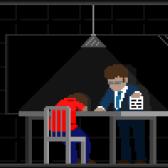
PCKWCK began as a legal declaration written by a protagonist, Shamil Al-Waked, against PCKWCK, which — in this adaptation so far — is a mysterious, corporate-type entity. Cohen abandoned the form of the legal document after about 19 bullet points, instead abruptly placing the character into an interrogation and torture scene.

In some ways, Cohen isn’t being subtle at all in PCKWCK about what he wants to say: In the first chapter, Shamil, a writer, disappears from a public cafe while in the middle of carefully, slowly deliberating over a single sentence he’d written that wasn’t quite right. The resonances with Cohen’s own thoughts about the carefully chosen, perfect words and the volume and tone of today’s communicative realities are obvious

There’s still a lot to process personally, Cohen said, about this entire experiment, and he hesitated to wade into too dark of a territory while speaking to a reporter on Tuesday morning. For day two, he had one concern he wanted to address: that he was being too subtle about what he thought of the commenters.

“I was actually shocked — I don’t mean to sound like an a**hole — that when I got to the middle of the story, that people didn’t seem to see or care where it was going and that, as my commentators, they were being cast in the role of my future torturers,” he said.

For day two, Cohen set out to be “the opposite of subtle” on this point. “I’m going to be plagiarizing them, you know?” True to his word, Chapter Two begins with a lengthy cut-and-paste of some of the worst comments thrown his way from the first day.

You can participate in PCKWCK here, and the chatroom seems to work even when Cohen isn’t writing. It’s probably best not to wait until the whole project is finished to take a look at what Cohen has written. The entire thing disappears from the Internet on Friday after Cohen finishes and will become a very limited-run printed novel later this year. All proceeds from the printed result will go to the ACLU.

Sept. 10, 2016 "Why fiction is good for you": I cut out this article by Kate Taylor in the Globe and Mail on Sept. 10, 2011:


When psychologist and author Keith Oatley writes his next novel, he can make sure that each description of a scene includes three key elements – to better help the reader create a vivid mental image. Not one element; that would be forgettable. Not six elements; that might be boring.

He could have learned this from Anton Chekhov, master of the short story. Oatley, a great admirer of the Russian writer, recalls one Chekhov story that includes a description of a pond under snow. With a factory. Across from a village.

In fact, Oatley learned the lesson from a study that used MRI scans to show brain activity in readers: The area of the brain used to create a mental image was best activated when descriptive passages used three elements.

Oatley, professor emeritus of cognitive psychology at the University of Toronto, is also the author of three novels, including The Case of Emily V. which won the Commonwealth Prize in 1994, but his most recent work combines the two fields. Such Stuff as Dreams: The Psychology of Fiction is part of a growing movement to find hard evidence for a soft pursuit, looking to various sciences to explain the power of fiction. Contrary to the notion that art merely copies life, Oatley's argument is that a movie, play, story, poem or novel creates a mental model in which readers can try out ideas about themselves and others.

“If you say fiction to anybody, they immediately say ‘Oh, something that has been made up.' … What you really want to know is what is the subject matter of fiction,” he said. “The subject matter of fiction is what people are up to with each other and within themselves, what it is to be a self, interacting with others in the social world. … If you want to read about genetics you read [Richard]Dawkins or someone, and you get good at understanding genetics. If you read fiction, what you get good at understanding is what goes on between people.”

Oatley and his several colleagues are actually trying to measure that knowledge. In one study, they used a test in which subjects are asked to choose the emotion expressed in a photograph of a person's eyes, a measure of empathy developed by the British psychologist Simon Baron-Cohen, who studies autism. Fiction readers scored higher, even when the psychologists subtracted out influences that might suggest the more empathetic people would tend to read more fiction.

To further test that empathy is a product of reading fiction rather than the reverse, York University psychologist Raymond Mar experimented with two groups of randomly selected subjects, one of which read a short story and the other a piece of non-fiction. He then subjected them to a test of social reasoning and found the short-story group performed better.

Oatley would like to repeat such a study with a much larger group over a longer time period, perhaps signing up subjects who would agree to read only fiction or non-fiction for a year.

In another study, Oatley's UofT colleague Maja Djikic rewrote the Chekhov short story The Lady with the Little Dog as a piece of non-fiction, as though this story of an illicit love affair were the transcript of a trial. When asked to perform standard personality tests, subjects who had read the real thing instead of her rewrite showed more signs of shifts in character traits. And the more emotions they reported feeling during their reading, the more they changed. There was no particular direction to these shifts in personality: If propaganda, rhetoric or marketing aims to push the reader one way, fiction simply opens up the possibility of movement.

“It is not that one puts bread into a toaster and it makes toast,” Oatley said. “It is an opportunity for the reader or the movie watcher to change. It's not a straight causal effect.”

Stressing the studies are preliminary, he speculates the personality shifts may be produced by the reader entering into the fictional character's mind.

He uses the metaphor of a flight simulator to explain fiction's role in our lives: Just as the flight simulator allows the pilot-in-training to quickly and safely encounter all sorts of contingencies that might happen in the air, so fiction allows us to experience emotions in a safe place, training us to understand ourselves and others.

Jane Austen's Pride and Prejudice is a wonderful example of the simulator effect. In the novel, Elizabeth and Darcy, both of them intelligent and proud, initially misread each other, but gradually come to an understanding of one another's minds that will then grow into love. Oatley points out that the reader undergoes a similar process, coming to know and love the characters as Austen unfolds their story, thus experiencing the same dawning understanding and growing attachment.

“That is a beautiful structure,” he said.
This function also explains why reading groups are popular, and in Oatley's scheme, very important: They take the emotional training and multiply the effect.

“When you read the book yourself you have a particular understanding, but it is always very partial, so the moment you start talking with someone else about it, you are increasing the amount of brain power and coming at if from all these different directions,” Oatley said. He has participated in the same book club for 20 years and finds its discussions often deepen his understanding not just of the book, but also of his friends in the group.

So, a book club improves what psychologists call “theory of mind.” Acquired around the age of five, theory of mind is our awareness of our own and others' consciousness – and of the possibility they may believe something different from us.

U.S. English professor Lisa Zunshine was one of the first to suggest fiction trains us in theory of mind. Similarly, U.S. philosopher Martha Nussbaum has argued that fiction teaches empathy, and so should be required reading for public leaders.

Following that work, Oatley's cognitive approach is part of a trend toward seeking concrete explanations for literature's utility both inside and outside the English department. The so-called literary Darwinists see evolutionary purposes behind a kind of mental training that is crucial to living in groups, and argue that storytelling has evolved as an art form because of the prestige that accrues to the socially necessary storyteller.

The evolutionary theorists put great emphasis on the storyteller; Oatley prefers to give pride of place to the reader. But both schools do permit their practitioners to judge the writer's art, even as some literary critics complain these new approaches are reductionist. Brian Boyd, a Nabokov scholar from New Zealand, subjects The Odyssey and Horton Hears a Who to evolutionary criticism in his recent book On the Origin of Stories: Evolution, Cognition and Fiction. He shows how the master storyteller holds his audience's attention and draws it toward particular aspects of his tale: Through the sympathetic Horton, Dr. Seuss makes us feel for the plight of the microscopic Whos.

For his part, Oatley is convinced that the better the writer, the more powerful the simulation, and he makes a distinction between literary fiction and genre fiction.

“You can have a good read, but it is sort of like going on a roller coaster. The engineers have constructed it so you have a particular set of experiences. You get off, your heart is beating a bit, but you are still the same person,” he says of reading a thriller or detective story. On the other hand, “Chekhov was a great artist: The effect is different – the extent to which [the reader]can really inhabit another mind.”

The roller coaster may be fun, but the flight simulator … now that's art.

My opinion: This is like a psychology article.


Sunday, September 11, 2016

"From the Ashes" (Sept. 11)

Aug. 28, 2016 "From the Ashes": I cut out this article by Suzanne Craig in the National Post on Sept. 10, 2011.  It was about Sept. 11, 2001.  This was in the business section of the newspaper.  It is about a business called Cantor Fitzgerald and the boss Howard Lutnik in the World Trade Center:

Ten years and a lifetime ago, Howard Lutnick was a prince of Wall Street. Forty years old, and already the head of a powerful financial house, he could peer down on rivals from his office on the 105th floor of One World Trade Center. Then — you know the rest. American Airlines Flight 11 struck Tower One. Three out of every four people who worked in New York City for Mr. Lutnick at brokerage firm Cantor Fitzgerald died that September morning, 658 in all. Among the dead was his younger brother, Gary.

That Howard Lutnick survived was, he concedes, blind luck. Some people died because they happened to be at the World Trade Center on Sept. 11, 2001. Mr. Lutnick lived because he happened to be taking his son, Kyle, to his first day of kindergarten.

And so Mr. Lutnick, who ran Cantor Fitzgerald then and, remarkably, still runs it today, became an unusual, and unusually public, 9/11 survivor: the executive who cried on national television and then quickly began making hard-nosed — some said hardhearted — business decisions. Four days after the attack, with the nation stunned and ground zero smoldering, Mr. Lutnick cut off paycheques to the families of his employees, before anyone even knew just how many had died.

“I was disgusted,” one widow, whose husband had worked at a Cantor subsidiary, told television anchor Connie Chung later.

And yet, since those dark days, Mr. Lutnick has defied those who said he and Cantor were finished. He has rebuilt his firm, and then some. And many of those who criticized him at the time, notably, spouses and parents of Cantor employees who had died, now say he did the right thing.

By almost any measure, it is a remarkable turnabout. Perhaps more than any other company, Cantor came to symbolize the horrors of Sept. 11. In the number of employees who died, it has no rival. Almost one-fourth of the 2,753 people killed in New York City that morning worked for Mr. Lutnick.

Now 50, he occupies offices in a far lesser skyscraper, a smoked-- glass affair in Midtown Manhattan. He sits 103 stories lower than before, on the second floor.

Perched on the credenza near his desk is a bronze sculpture of a hand, a Rodin that was recovered from the wreckage of the towers. It is a vestige of the vast collection that his mentor, Bernie Cantor, amassed over a lifetime. The finish is seared. Several fingers are missing.

The sculpture is a reminder, as if one were needed, of Mr. Lutnick’s improbable journey back.

And it is improbable. Together, Cantor Fitzgerald and BGC Partners, a company he founded after Sept. 11, now employ roughly 5,000 people. That is 2,900 more than Cantor Fitzgerald employed before the attacks. Only 74 remain from the pre-9/11 days.

Mr. Lutnick has slowly rebuilt old businesses and pushed into new ones, including, of all things, sports betting in Las Vegas.

“I believe in what I call the surfer’s theory,” he says. “You see a really, really big wave. You keep surfing, keep going forward. You just don’t look back.”

He is a tough customer. Orphaned in his teens, he bootstrapped his way to the top of the Wall Street bond business. In their heyday, Cantor brokers occupied a lucrative niche as the main middlemen in the enormous market for United States Treasury securities. Cantor Fitzgerald never had the cachet of, say, Goldman Sachs, and it was in some ways a throwback to the time when sons followed fathers and brothers onto the trading floors, when polish and an Ivy League degree mattered less than some fire in the belly.

There is no sugar-coating the fact that before, and even after, Sept. 11, Mr. Lutnick was widely disliked in the industry. A ruthless competitor even by Wall Street standards, he has made more than a few enemies over the years. In 1996, as Mr. Cantor, his mentor, lay dying, Mr. Lutnick fought with Mr. Cantor’s wife, Iris, for control of Cantor Fitzgerald. She later barred him from the funeral.

Such was Mr. Lutnick’s reputation that in the days and weeks after Sept. 11, some of his rivals actually gloated over Cantor’s devastation. They jumped at the opportunity to put an end to his firm, which pocketed many millions in commissions while enabling the great investment houses to trade bonds in relative anonymity.

All of which makes Cantor’s rebirth, and the redemption of Mr. Lutnick, all the more remarkable. “We dealt with this by quietly doing everything we said we would do,” he says of the past decade. “The only way to take care of everyone was to have a company.” Mr. Lutnick was shouting into the throng pouring out of the blazing World Trade Center on Sept. 11. He had rushed to what would become known as ground zero from a classroom at the Horace Mann School, on the Upper East Side, where he had just dropped off Kyle for kindergarten.

What Mr. Lutnick wanted to know was, what floor had people been on? Sixty-seven? Seventynine? The highest number he heard was 91, at least 10 flights
below the Cantor offices. Then the north tower began to fall, floor by floor by floor, and Mr. Lutnick ran. He dove under a car, choking on the dirt and dust.
No one on the 101st floor, where Cantor’s headquarters began, had made it out.

Mr. Lutnick spent the next four hours picking through the stunned crowds streaming uptown. As he walked to his home on the Upper East Side, the enormity of what had happened began to sink in.

So many Cantor brokers were killed that Mr. Lutnick had little choice but to shut many of his trading desks. There simply were not enough people left to handle the work.

“The show starts on Wall Street at about 7:30 in the morning, when the curtain goes up,” Mr. Lutnick said. That meant that almost all of his brokers were at their desks when Flight 11 hit: “Everyone who made money for the firm was there.”

The numbers tell the story. On Sept. 10, 2001, Cantor employed 2,100 employees worldwide, 960 of them in New York City. On Sept. 12, only 1,422 were left, roughly half of them in London, and 302 in New York.

And so the desks for corporate bonds, mortgage securities and municipal bonds were closed. So were the offices in Paris and Frankfurt. Cantor was losing a million dollars a day, and that was excluding compensation still being paid to its families.

Unable to reach Mr. Lutnick on Sept. 11, Lee Amaitis, the head of the London office and a friend, began mapping out a plan. He helped reconfigure Cantor’s trading systems so that trades could be processed through London, rather than New York.

Mr. Lutnick and his remaining employees in New York soon decamped to a windowless computer centre in Rochelle Park, N.J. Thanks to its electronic trading subsidiary eSpeed, Cantor could clear its trades electronically. Forty-seven hours after the planes hit, as the bond market nervously reopened for business, so did Cantor.

“From survival to when we could take a breath was weeks,” Mr. Amaitis said.
For many, Mr. Lutnick would become the public face of a Wall Street besieged.

“Every person who came to work for me in New York, everyone who was at the office, every single one who was there isn’t there anymore,” he told Larry King on CNN on Sept. 19, his voice cracking. “We can’t find them. All of them. Everyone.”
Mr. Lutnick today defends his decision to stop the paycheques of employees who were dead or missing, a step that drew howls at the time. “It was just math,” he says. “We lost all our producers. There simply was no money.”

But Mr. Lutnick had already come up with another plan, one that would become one of the most expensive corporate efforts of its kind. Cantor, he promised, would give the families 25% of its profits over the next five years. And it would provide health-insurance coverage to families for 10 years.

Mr. Lutnick’s plan was met with a wall of skepticism. Cantor, after all, was losing money. Angry families jeered that 25% of nothing was nothing.
Then, that October, Cantor sent out more than US$45-million in bonus payments, the first of many cheques to come.

“After the first cheques went out, guess what happened?” Mr. Lutnick asked. “Silence. Because the cheques were larger than the salaries we were paying.”
Its ranks depleted, Cantor could not hire fast enough. For the first year, Mr. Lutnick estimated that he signed up 10 new people a week. By the end of 2002, the firm had roughly 750 people in New York.

Cantor is privately held and does not make public all of its financial information. But based on data released by the company and payouts to families, Cantor and eSpeed made about US$150-million a year, on average, in the five years after the attacks.
For all its losses and sorrows, Cantor actually had the wind at its back.

My week:


Sept. 5, 2016 Ambercrombie closing 60 stores: I read this in the newspaper last week.  There is still a location at West Ed mall.  Don't be surprised if the WEM location closes down.  A lot of retail stores are closing. 


Parking lot: I'm going through my "parking lot" email drafts where I put some stories and things to write about later.  Now I will clear it all out.  It's what I will do now like I do with the newspaper.  As soon as I see a story, I will copy and paste it into it's own drafts and write about it right away, though I will send it later.  I only send 3 emails a week.

This is going to be kind of random topics.  Then again, when you read "my week" section, it is often random.

"Hayter makes most of cameo": I read this article by Samantha McKay in the Edmonton Journal on Mar. 3, 2016:

I learned Rob Hayter is from AB.  He is on a new TV show called Van Helsing:

"Vanessa Helsing, distant relative of famous vampire hunter Abraham Van Helsing, is resurrected only to find that vampires have taken over the world. She is humanity's last hope to lead an offensive to take back what has been lost. "


On Wikipedia it say it's on Syfy.  I don't have that channel, but I do want to see it.


Chris Wood: I see that I had put a link of the show in "parking lot".


Containment:


I see that on Supergirl imdb.com page, he is "rumored" to play Mon - El.

Lar Gand, known primarily as Mon-El (and alternatively as Valor and M'Onel), is a fictional character in DC Comics' universe who is associated with the Legion of Super-Heroes, Superboy, and Superman. The character has been reinterpreted over the years, but in all versions serves as a hero with abilities similar to those of Superman, sometimes serving as a substitute for the better-known character.


Funny Heidi Klum video: Does anyone remember this video?  Trump say Klum is no longer a 10.  Klum has a video where someone wears a Trump mask and takes off the 10 off her.  She is a 9.  She shrugs.  lol.


Disappearance of Maura Murray: I read about her in an old Seventeen magazine.  She got into a car accident in 2004, and she may have left on her own. 


Here is new word I learned:

Sisyphean- adjective
1. of or relating to Sisyphus.
2. endless and unavailing, as labor or a task.


"For nearly 27 years, one man knew where Jacob Wetterling was.

Late last month, Danny Heinrich agreed to confess to killing the 11-year-old boy — setting in motion a flurry of difficult negotiations between defense attorneys, investigators and prosecutors that would put him behind bars for decades and finally unlock the secrets to a mystery that has long haunted the state of Minnesota.

"This was not an opportunity we could pass up," U.S. Attorney Andy Luger said. "After almost 27 years, Danny Heinrich was willing to talk, and we had to grab the moment."

Heinrich, 53, admitted Tuesday that he abducted, sexually assaulted and shot Jacob to death in 1989, then buried the boy's body in a field in rural central Minnesota. The confession came as part of a plea agreement in which Heinrich will likely get 20 years in prison on a federal child pornography charge when he's sentenced in November, but will not be prosecuted on state murder charges. Following his prison sentence, a civil commitment is possible, meaning he could spend the rest of his life in custody.

As part of the deal, which the family approved, Heinrich led authorities to Jacob's remains last week.

In the years after Jacob's disappearance, his mother became a nationally known advocate for missing children. A 1994 federal law named for Jacob requires states to establish sex offender registries.

My opinion: It was sad, but it got closure.  It was bittersweet.

Sept. 9, 2016 Filmmakers meetup: I went to one this week.  We meet every 2 weeks, but this is an extra one to make it into a non-profit.

Women's Network: On Telus free preview, I have this.  It has lots of romantic comedies, a couple of dramas, lots of home reality shows like Property Brothers.

Medical clinic: This clinic I go to is closing and moving somewhere else.  It's still easy to get to in the new location.  Hopefully, another clinic will replace the old one.  I'm mildly disappointed because the current one is so convenient.

Apple's "planned obsolescence": This mildly "grinds my gears."

I read about it in the Globe and Mail today, and I can't copy and paste it here:


But the company is increasingly coming under fire for engaging in a marketing practice known as “planned obsolescence” – a method of making products with shorter lifespans, or making current generation products seem obsolete in order to sell a “new and improved” version.


My opinion: Stop buying iPhones now.  I still have a flip phone.  I still use my discman and my stereo at home.  In 2006-2007, I really did want an iPod, but it was expensive.  I didn't really need it. 

Sept. 10, 2016: Stick with your old iPhone.

Quebec university ends vulgar event: This grinds my gears:

A university in Gatineau, Que., is investigating an on-campus event where students were given a list of challenges such as "kiss a girl" or "take a picture of someone's breasts," which critics condemned for promoting a culture that enables sexual assaults.

Students with Les Jeux de la Communication passed out a list of challenges — dubbed "The 12 labours of Hercules" — to other students that were worth points, including taking a picture of someone's breasts, taking a picture of someone's bra, kissing a girl or participating in a wet T-shirt contest.

After several students at the event shared the list on social media, the reaction was swift, according to the university's women's committee president Valerie La France.

"I think the response from everybody was they were furious," said La France. "They didn't understand how someone could think that was funny or think that was OK to do … everybody was outraged, everybody was already asking for actions from the university."

'Worst example of rape culture'


Sept. 10, 2016 TV and real life: Today is Sat. and is my day off.  I read the Edmonton Journal and the Globe and Mail today.  Later in the afternoon I watched Magic Mike on W network.  I had recorded it last night.  However, I think I missed the 1st 30min of the movie.  The DVR recorded it like that.

Now I am copying and pasting my book reviews onto my email drafts and will reread it and bold it when I post it onto my blog.  I will then give the articles to my co-worker S because she reads books.

Look, after watching Magic Mike, nothing will be as exciting tonight to top that.  I can't go out tonight, I have to wake up early tomorrow for work.

It's like on Wed. I watched the 2 hr Zoo season finale.  It was so fun and exciting.  I then went to the Filmmakers Meetup afterwards and had fun talking and meeting 3 new people.  However, will anything be more exciting then the Zoo characters travelling around the world and stopping animal attacks?